From demo to production
AI Agents That Work
A practical playbook for designing, governing and scaling agentic AI, by two practitioners who build agents inside a regulated bank.
Most agent demos impress. Most agent projects disappoint. The difference is rarely the model. It is the work.
Paperback out 20 November 2026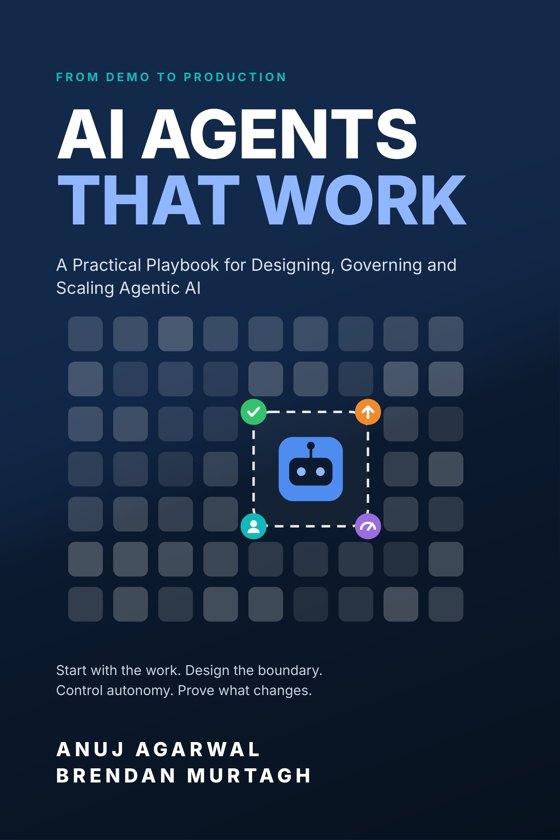
Agent design is the delegation of bounded work. A good agent does a clearly defined piece of that work, with explicit authority, controls and evidence.
Written for
Product and business leaders
Decide which work is worth an agent, and prove the value before you scale it.
Architects and engineers
Turn a vague brief into a bounded contract with tools, permissions and evals you can test.
Risk, control and compliance owners
Choose autonomy action by action, and know exactly where a person stays in the loop.
Executives sponsoring AI
Ask the questions that separate an impressive demo from a system the organisation can rely on.
The book in five ideas
What separates a demo from an agent you can trust
The book follows one sequence. If a later step gets hard, the fix is usually upstream.
Start with the work
Human Twin Design
Job titles are poor agent boundaries. Shadow a skilled colleague on a real case and write down what they notice, remember, judge, do and escalate. Each becomes something you can build, control and test.
You are learning the work, not cloning the person.
Design the boundary
The OPT model
"Build an onboarding agent" names a domain, and nobody can own or test a domain. Zoom from Operating model to Process to Task until the owner, the evidence and the definition of done are clear.
Good agent boundaries are usually discovered, not declared.
Control autonomy
Minimum useful autonomy
Autonomy is chosen action by action, from the consequence of a mistake. One agent can retrieve a document on its own, recommend with sampled review, and wait for a person before approving anything that matters.
Autonomy is earned by evidence and consequence, not by model capability alone.
Prove what changes
Evals that change decisions
A demo shows one success. Production asks how behaviour holds across thousands of runs, edge cases and changing data. A useful eval decides something: release, block, escalate or redesign.
If you cannot evaluate the work, you do not yet control it.
Run it as a product
Ownership, cost and value
Most of an agent’s lifetime cost arrives after go-live, and the model is rarely the biggest line. Name an owner for every part of its life and measure cost per good outcome, not cost per call.
The model was 4p. The outcome cost 61p. Manage the 61p.
Explore
Try the method before you buy the book
- Read a free extractThree short passages from the book, exactly as they appear in print.
- Use the reader toolkitThe five-gate test, the cost-per-outcome calculator, a launch checklist and the Agent PRD template.
- See what is insideEight parts and fourteen chapters, from first principles to your first build.
- Meet the authorsAnuj Agarwal and Brendan Murtagh, two practitioners building agents inside a regulated bank.
Support the book
Know someone building an agent? Send them this.
The book grows by word of mouth. A share with whoever owns your agent roadmap, or a copy for yourself, helps more than you think.
Get the book
The best agent is not the most autonomous one.
It is the one whose value, boundary, controls and evidence are clear.
Available now
Kindle eBook
Read tonight on any device. Searchable, with every canvas and checklist one tap away.
Buy on AmazonOut 20 November 2026
Paperback
The desk copy for design reviews, with the workbook canvases ready to mark up.
Paperback out 20 November 2026For organisations
Team copies and talks
Bulk copies for your team, or a talk or workshop on applying the method to your own agents.
Message Anuj on LinkedInQuestions
Before you buy
Do I need to be technical to read it?
No. Every core idea comes with a plain-English explanation and an everyday analogy. Engineers get a technical field guide and worked examples; leaders get the decisions and questions that matter.
Is it tied to a particular model or vendor?
No. The method is about the work, the boundary, autonomy, evidence and ownership. It holds whichever model or framework you use, and it will outlast the current tooling.
What will I be able to do after reading it?
Pick the right first agent, write its contract and one-page Agent PRD, choose autonomy action by action, design evals that drive decisions, and cost it per good outcome.
Can I buy copies for my team?
Yes. For team or bulk copies, or a talk or workshop built around the method, message Anuj on LinkedIn.